
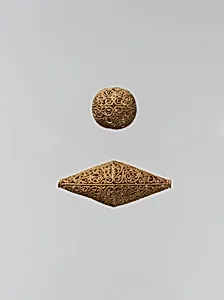
Spherical Bead
Unknown Artist
11th century
Medium
Gold; filigree and granulation
Dimensions
Diam. 13/16 in. (2.1 cm)
Classification
Jewelry
Department
Islamic Art
Museum
Metropolitan Museum of Art, New York, NY
Credit
Purchase, Mobil Foundation Inc. Gift, 1980
Accession Number
1980.457
Rights
Public Domain
Art Historical Context
This exquisite *Spherical Bead*, in the 11th century, exemplifies the pinnacle of Islamic goldsmithing from the medieval Islamic world. Measuring just 13/16 inch (2.1 cm) in diameter, this tiny sphere of pure gold was likely part of a larger necklace or adornment, showcasing the era's mastery of intricate jewelry making. Acquired by the Metropolitan Museum of Art through Mobil Foundation Inc. Gift 1980, it in the Department of Islamic Art, highlighting the sophistication of artisans whose identities remain unknown but whose skill speaks volumes. The bead's surface is adorned with *filigree*—delicate wires twisted and soldered into ornate patterns—and *granulation*, a technique involving the fusion of minuscule gold granules to create textured, shimmering motifs. These methods, perfected in the Islamic realms during the Abbasid and Fatimid periods, demanded extraordinary precision and reflected a cultural reverence for beauty in everyday luxury. Such beads were symbols of wealth and status, often traded along Silk Road routes, blending artistry with portability. Today, this unassuming jewel invites us to marvel at the anonymous craftsmen's ingenuity, preserving a glimpse of 11th-century Islamic elegance in a form both functional and breathtaking.