
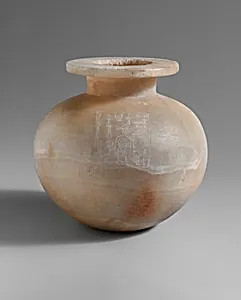
Spherical Jar Inscribed with Hatshepsut's Titles as Queen
Unknown Artist
ca. 1492–1473 B.C.
Medium
Travertine (Egyptian alabaster)
Dimensions
H. 12.3 cm (4 13/16 in.); diam. 12.8 cm (5 1/16 in.)
Classification
Jar, spherical, Hatshepsut
Period
New Kingdom
Department
Egyptian Art
Museum
Metropolitan Museum of Art, New York, NY
Credit
Rogers Fund, 1917
Accession Number
18.8.15
Rights
Public Domain
Tags
Art Historical Context
This delicate spherical jar, crafted from shimmering travertine—known as Egyptian alabaster—is a exquisite artifact from Egypt's New Kingdom, dating to around 1492–1473 B.C. during Dynasty 18. Standing just 12.3 cm tall a 12.8 cm diameter, it once likely held precious oils or cosmetics, a common use for such vessels in elite households. Its surface bears finely carved hieroglyphs inscribing the royal titles of Hatsheps, one of ancient Egypt's most remarkable female pharaohs, boldly assumed kingly authority during her reign. The choice of Egyptian alabaster highlights masterful ancient techniques: this soft, translucent stone from quarries near the Nile was prized for its luminous quality and ease of carving intricate details. Artisans hollowed the jar into a perfect sphere, a form symbolizing completeness and eternity in Egyptian cosmology, then meticulously incised the hieroglyphs to proclaim Hatshepsut's queenship. These inscriptions served not just as decoration but as a powerful assertion of legitimacy and divine right. Housed in the Metropolitan Museum of Art's Egyptian Art department (acquired via the Rogers Fund in 1917), this jar offers a intimate glimpse into the opulence and political savvy of early Dynasty 18. It embodies the era's artistic excellence, where everyday objects became canvases for royal propaganda, bridging the worlds of utility and eternity.