
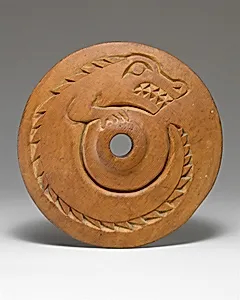
Spindle Whorl
Unknown Artist
ca. 1860
Medium
Wood
Dimensions
Diam. 7 1/4 in. (18.4 cm)
Classification
Wood-Implements
Culture
Salish
Department
Arts of Africa, Oceania, and the Americas
Museum
Metropolitan Museum of Art, New York, NY
Credit
Ralph T. Coe Collection, Gift of Ralph T. Coe Foundation for the Arts, 2011
Accession Number
2011.154.50
Rights
Public Domain
Art Historical Context
This intricately carved wooden spindle wh, created by an unknown Salish artist around 1860, hails from the Pacific Northwest Coast of North America. Measuring just 7¼ inches in diameter, it served as a vital tool in traditional Salish textile production. Affixed to the end of a spindle, the whorl's weight provided momentum for twisting wool or plant fibers into yarn, enabling the creation of finely woven blankets, robes, and regalia that were central to Salish daily life, trade, and ceremonies. Salish women, renowned as skilled weavers, crafted these implements not only for function but as canvases for artistic expression. The wood—likely alder or maple—was meticulously hand-carved with knives and chisels, often featuring stylized motifs of animals, humans, or geometric patterns that encoded cultural stories, spiritual beliefs, and clan identities. Dating to the mid-19th century, this piece reflects a pre-colonial tradition persisting amid early European contact, underscoring the resilience of Indigenous knowledge and craftsmanship. Today, housed in The Metropolitan Museum of Art's Department of Arts of Africa, Oceania, and the Americas (gift of the Ralph T. Coe Foundation, 2011), it invites us to appreciate how everyday objects embodied profound cultural significance, bridging utility and artistry in Salish society.