
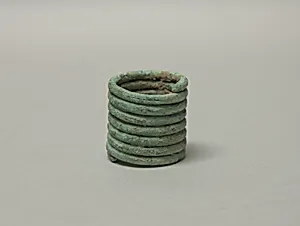
Spiral Ring
Unknown Artist
300 BCE–CE 300
Medium
Bronze
Dimensions
L. 1 in. (2.5 cm); Diam 1 in. (2.5 cm)
Classification
Jewelry
Culture & Period
Thailand · Late period
Department
Asian Art
Museum
Metropolitan Museum of Art, New York, NY
Credit
Samuel Eilenberg Collection, Bequest of Samuel Eilenberg, 1998
Accession Number
2001.433.304
Rights
Public Domain
Art Historical Context
This delicate **Spiral Ring**, crafted from bronze around 300 BCE to 300 CE, hails from ancient Thailand during its Late Period. Measuring just 1 inch (2.5 cm) in both length and diameter, this jewelry piece exemplifies the exquisite metalworking skills of early Southeast Asian artisans. Now housed in the Metropolitan Museum Art's Asian Art Department part of the Samuel Eberg Collection (bequest, 1998), it us to marvel at everyday adornments from a distant era. Bronze, a hallmark of advanced metallurgy in ancient Thailand, was prized for its durability and luster, making it ideal for personal ornaments like rings. The spiral form—evident in its coiled design—reflects motifs common in prehistoric and early historic Southeast Asian art, possibly symbolizing continuity, growth, or natural forms like vines or snakes. Such jewelry likely served both decorative and social functions, adorning fingers to signify status or cultural identity. Though the artist remains unknown, this ring offers a tangible link to Thailand's vibrant Bronze Age legacy, where communities like those in the Ban Chiang region pioneered sophisticated casting techniques. A small treasure, it whispers stories of ancient lives, craftsmanship, and cultural exchange across Asia.