
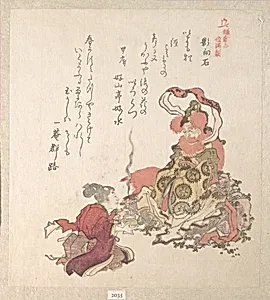
『春雨集』 摺物帖窪俊満画 『鎌倉志』 「影向石」|Spring Rain Collection (Harusame shū), vol. 1: “Offering Incense to the Deity of the Stone” (Yōgōishi), from the series History of Kamakura (Kamakura shi)
early to mid-1810s
Medium
Privately published woodblock prints (surimono) mounted in an album; ink and color on paper
Dimensions
7 7/8 x 7 1/8 in. (20 x 18.1 cm)
Classification
Prints
Culture & Period
Japan · Edo period (1615–1868)
Department
Asian Art
Museum
Metropolitan Museum of Art, New York, NY
Credit
H. O. Havemeyer Collection, Bequest of Mrs. H. O. Havemeyer, 1929
Accession Number
JP2035
Rights
Public Domain
Tags
Art Historical Context
Kubo Shunman's *Spring Rain Collection (Harus shū)*, volume 1, features the evocative scene “Offering Incense to theity of the Stone” (Yōgōishi) from his series *History of Kamakura (Kamakura shi)*. Created in the early to mid-1810s during Japan's Edo period (1615–1868), this intimate woodblock print captures a moment of reverence at a sacred Kamakura site, blending historical narrative with poetic elegance. Kamakura, the 12th-century capital of the samurai shogunate, inspired such works as artists romanticized its ancient temples and legendary stones believed to house deities. As a privately published *surimono*—luxurious woodblock prints often commissioned for New Year's or poetic gatherings—Shunman's piece exemplifies ukiyo-e artistry at its refined peak. Mounted in an album with vibrant ink and color on paper (measuring just 7⅞ × 7⅛ inches), it showcases meticulous carving and printing techniques, including subtle gradients (*bokashi*) and possibly metallic accents for a shimmering effect. Shunman, a versatile poet-painter, infused his designs with literati sophistication, making these albums cherished collector's items among Edo elites. This work from the Metropolitan Museum of Art's H. O. Havemeyer Collection highlights surimono's cultural role in fostering private artistic circles, preserving Kamakura's spiritual legacy amid urban Japan's fleeting pleasures. Visitors will appreciate its delicate scale and timeless devotion, a window into Edo-era piety and craftsmanship.
About the Artist
Kubo Shunman · 1757–1820
Japanese, 1757–1820