
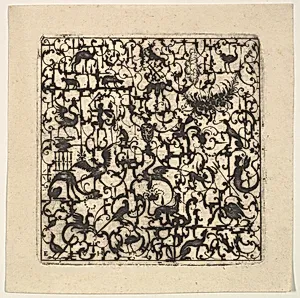
Square Blackwork Design in Silhouette Style with Schweifwerk and Grotesque Figures
Medium
Blackwork
Dimensions
Plate: 4 7/16 x 4 3/8 in. (11.2 x 11.1 cm)
Classification
Prints|Ornament & Architecture
Department
Drawings and Prints
Museum
Metropolitan Museum of Art, New York, NY
Credit
Harris Brisbane Dick Fund, 1933
Accession Number
32.123.11
Rights
Public Domain
Tags
Art Historical Context
Created in 1617 by German engraver Esaias von Hulsen, this compact blackwork print exemplifies the intricate ornamental designs popular in early seventeenth-century Europe. Blackwork, a specialized engraving technique that employs dense networks of fine lines and dots to achieve rich tonal effects without cross-hatching, allowed artists to produce elegant silhouette-like patterns suitable for reproduction. Von Hulsen’s square composition blends Schweifwerk—flowing, strap-like scrollwork—with grotesque figures, birds, and even camels, merging fantastical and exotic motifs in a tightly balanced design. Such prints belonged to a flourishing category of ornament and architecture models circulated among craftsmen, goldsmiths, and architects. At just over four inches square, this plate was likely intended as a practical source for decorating metalwork, textiles, or architectural details. The inclusion of camels reflects the period’s growing fascination with distant lands, brought to European audiences through travel accounts and trade. Today the sheet survives in the Metropolitan Museum’s collection as a vivid reminder of how small engraved designs shaped the visual language of the Baroque era.