
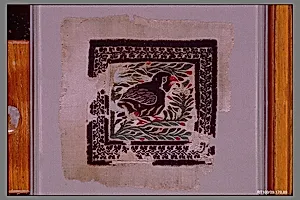
Square with Quail
Unknown Artist
probably 5th century
Medium
Wool, linen; plain weave, tapestry weave
Dimensions
Max. H. 10 1/2 in. (26.5 cm) Max. W. 10 1/4 in. (26 cm)
Classification
Textiles
Department
Islamic Art
Museum
Metropolitan Museum of Art, New York, NY
Credit
Gift of George F. Baker, 1890
Accession Number
90.5.150
Rights
Public Domain
Art Historical Context
This charming textile fragment, titled *Square with Quail*, hails from the 5th century and exemplifies early weaving traditions preserved in the Metropolitan Museum of Art's Islamic Art. Measuring just over 10 inches square, it features a delicate depiction of a quail within a bordered square, rendered in wool and linen threads. Donated in 1890 by George. Baker, this small yet evocative piece offers a window into ancient textile artistry, likely originating from a region influenced by early Islamic cultural exchanges. Crafted using a combination of plain weave for the sturdy ground fabric and tapestry weave for the vibrant motifs, the artwork showcases sophisticated technical skill. Tapestry weaving allowed artisans to interlock colored wefts, creating bold, durable patterns without floats—ideal for garments, hangings, or cushions. The quail motif, a recurring symbol in ancient Near Eastern and Islamic decorative arts, evokes themes of nature and abundance, highlighting the period's appreciation for stylized fauna. As a rare survivor from antiquity, *Square with Quail* underscores the centrality of textiles in daily life and trade across the Islamic world. These portable luxuries connected distant cultures, blending functionality with aesthetic delight for both elite patrons and everyday users.