
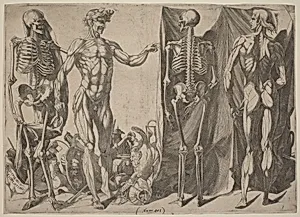
Squelettes et Ecorches
c. 1540-1545
Medium
engraving
Dimensions
plate: 23.7 × 33.3 cm (9 5/16 × 13 1/8 in.) sheet: 24 × 33.7 cm (9 7/16 × 13 1/4 in.) mount: 26.8 × 37.6 cm (10 9/16 × 14 13/16 in.)
Classification
Department
CG-E
Museum
National Gallery of Art, Washington, D.C.
Credit
Andrew W. Mellon Fund
Accession Number
1978.2.1
Rights
Public Domain
Art Historical Context
Domenico del Barbiere’s engraving *Squelettes et Écorchés* captures the Renaissance fascination with human anatomy through a striking arrangement of skeletons and flayed figures. Created around 154–1545, the reflects the period’s growing interest in scientific observation and the artist’s training in precise draftsmanship. Working in France as part of the School of Fontainebleau, del Barbiere translated Italian Mannerist sensibilities into detailed reproductive prints that served both artistic and educational purposes. Engraving was ideally suited to this subject, allowing fine lines to render muscles, bones, and tendons with remarkable clarity. Such images helped artists study the body’s underlying structure without relying solely on dissections, which remained limited and controversial. The work’s careful composition turns anatomical study into an elegant visual lesson, blending scientific curiosity with artistic refinement. Today the print stands as a testament to the era’s dialogue between art and science, offering viewers a window into how Renaissance creators sought to understand and represent the human form.