
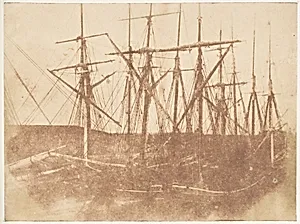
St. Andrews (?). Ships in the Harbor
Medium
Salted paper print from paper negative
Classification
Photographs
Department
Photographs
Museum
Metropolitan Museum of Art, New York, NY
Credit
Harris Brisbane Dick Fund, 1937
Accession Number
37.98.1.24
Rights
Public Domain
Tags
Art Historical Context
**St. Andrews (?). Ships in the Harbor**1843–47) is a captivating salted paper print from a paper, created by the pioneering Scottish partnership of David Octavius Hill and Robert Adamson., a noted painter, teamed up with the technically gifted Adamson in 1843 to document Scottish life through the revolutionary calotype process—a Talbot-patented method using paper negatives that allowed for multiple prints with a soft, painterly quality. This image, housed in the Metropolitan Museum of Art's Photographs Department (Harris Brisbane Dick Fund, 1937), likely captures the bustling harbor of St. Andrews, Scotland's historic coastal town famed for its ancient university and ruined cathedral. The artwork exemplifies the early days of photography, when artists like Hill and Adamson bridged painting and the new medium. Their calotypes, produced between 1843 and 1848, produced over 2,500 images, blending Hill's compositional eye with Adamson's chemical expertise. Salted paper prints, with their warm tones and subtle textures, evoke the era's maritime vibrancy—ships at anchor symbolizing Scotland's seafaring heritage amid the Industrial Revolution. This serene yet evocative scene invites visitors to ponder photography's humble beginnings: fragile prints from experiments that forever changed how we see the world. Gaze closely at the delicate ships and horizon; it's a window to 19th-century Scotland frozen in silver salts. (198 words)
About the Artist
David Octavius Hill|Robert Adamson|Hill and Adamson · 1802–1870
David Octavius Hill (1802–1870) was a Scottish painter, photographer, and arts administrator whose pioneering photography partnership with Robert Adamson from 1843 to 1847 transformed the medium into an art form. Born in Perth and trained in Edinburgh, Hill established himself as a landscape painter and became secretary of the Royal Scottish Academy, a position he held for nearly forty years. His ...