
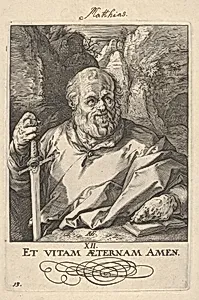
St. Matthias, from Christ, the Apostles and St. Paul with the Creed
ca. 1589
Medium
Engraving
Dimensions
plate: 6 x 4 1/8 in. (15.2 x 10.5 cm) sheet: 8 5/16 x 6 1/16 in. (21.1 x 15.4 cm)
Classification
Prints
Department
Drawings and Prints
Museum
Metropolitan Museum of Art, New York, NY
Credit
Bequest of Phyllis Massar, 2011
Accession Number
2012.136.471.13
Rights
Public Domain
Tags
Art Historical Context
Behold Hendrick Goltzius's *St. Matthias, from Christ, the Apostles and St. Paul the Creed* (ca. 1589), masterful engraving that captures of the apostles in a revered series of religious prints. Goltzius, a Dutch artist of the Mannerist era based in Haarlem, created this work amid the late 16th-century Northern Renaissance, when intricate prints like these served as affordable devotional aids for homes and churches during the Reformation's religious fervor. St. Matthias, chosen to replace Judas Isc, is depicted here alongside symbols evoking apostles and saints, including a sword that nods to martyrdom traditions. As an engraving on a modest plate (6 x 4 1/8 in.), this piece showcases Goltzius's virtuosic technique: swelling lines and cross-hatching that mimic the swelling contours of oil paintings, blurring the line between print and painting. His innovative burin work made engravings highly collectible, influencing generations of printmakers. Part of a larger set linking the apostles to the Creed, it underscores faith's communal recitation, blending theology with artistry. Today, housed in the Metropolitan Museum of Art's Drawings and Prints department (Bequest of Phyllis Massar, 2011), this print invites visitors to marvel at how a small sheet (8 5/16 x 6 1/16 in.) conveys profound spiritual weight through Goltzius's elegant precision.
About the Artist
Hendrick Goltzius · 1558–1617
Hendrick Goltzius (1558–1617) was the most celebrated engraver of the Northern Renaissance and a pivotal figure in Dutch Mannerism. Born near the German-Dutch border, Goltzius transformed printmaking into a virtuoso art form through his revolutionary 'swelling line' technique, where the burin was manipulated to create lines of varying thickness that produced unprecedented tonal effects and three-d...