
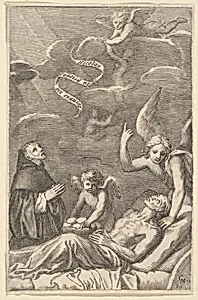
St. Nicolas Praying for a Dying Man
Medium
Engraving; second state of two (BN)
Dimensions
sheet: 4 x 2 5/8 in. (10.2 x 6.7 cm)
Classification
Prints
Department
Drawings and Prints
Museum
Metropolitan Museum of Art, New York, NY
Credit
Harris Brisbane Dick Fund, 1917
Accession Number
17.3.3264
Rights
Public Domain
Tags
Art Historical Context
Claude Mellan's *St. Nicolas Praying a Dying Man* is a delicate 17th-century engraving capturing a poignant moment from the life of the revered saint. Created by the French artist Claude Mellan (1598–1688), renowned for virtuoso line work, this intimate print depicts St. Nicholas in fervent prayer beside a dying figure, surrounded by ethereal angels. The second state of two, it measures just 4 x 2⅝ inches, inviting close contemplation of its intricate details. Mellan's mastery of engraving shines here, with fine, precise lines that convey emotion and movement in a compact format. As a leading Baroque printmaker who worked in Rome and Paris, he often explored religious themes, blending technical innovation—like his famous single-line portraits—with spiritual depth. This medium allowed wide dissemination of sacred imagery during the Counter-Reformation, making devotion accessible beyond grand altarpieces. Housed in the Metropolitan Museum of Art's Drawings and Prints department, thanks to the Harris Brisbane Dick Fund of 1917, the work highlights St. Nicholas's role as a miraculous intercessor, a popular motif in Catholic art. Its small scale belies its cultural resonance, offering visitors a window into 17th-century piety and the engraver's enduring skill.
About the Artist
Claude Mellan · 1598–1688
Claude Mellan (1598-1688) was a French draughtsman, engraver, and painter who became one of the most innovative printmakers of the French Baroque period. Born in Abbeville to a family of coppersmiths, Mellan rose to become Peintre et Graveur Ordinaire du Roi (Painter and Engraver in Ordinary to the King), achieving recognition for his extraordinary technical mastery. Mellan's artistic significanc...