
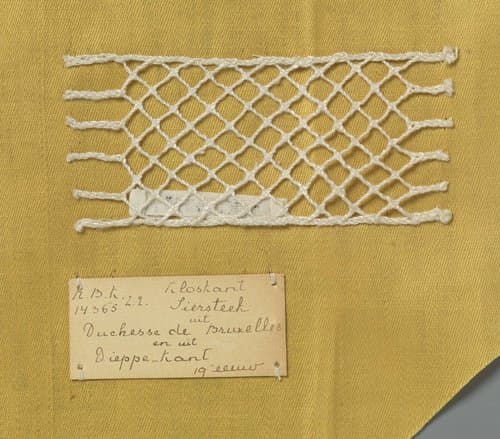
Staal kloskant met grove draad als voorbeeld van een Dieppe-grond
ca. 1900 - ca. 1930
Medium
bobbin lace
Dimensions
4; 8
Rights
Public Domain
About this artwork
De stalen kloskant uit de serie BK-NM-14365 zijn al dan niet met bijpassend kantfragment en met handgeschreven labels op een stuk geel textiel genaaid van ongeveer 65x55 cm groot.
Art Historical Context
This delicate bobbin lace sample, titled *Staal kloskant met grovead als voorbeeld van eenppe-grond*, showcases a traditional technique from the early 20th century (ca. 1900–1930). Measuring just 8 cm long by 4 cm wide, it exemplifies the intricate "Dieppe ground"—a fine, openwork mesh pattern originating from the lace-making hub of Dieppe, France. Named for its bold, coarse threads, this piece served as a practical trade sample, allowing artisans and merchants to demonstrate patterns without committing to full garments. Bobbin lace, or *kloskant*, is crafted by intertwining threads held on handheld bobbins over a pillow, creating a durable yet ethereal fabric prized for trims, collars, and veils. Dieppe's laces were renowned for their geometric precision and versatility, bridging 19th-century opulence with modern textile production. This anonymous example is part of the BK-NM-14365 series, where samples—with or without matching fragments—are meticulously sewn onto yellow textile mounts (ca. 65 x 55 cm) alongside handwritten labels, preserving techniques amid industrialization. In museum collections, such *staal* (samples) offer a window into lace's cultural role in fashion and craftsmanship, highlighting the skilled, often female-led labor that sustained Europe's textile heritage into the 1930s. A tiny testament to patience and precision!
About the Artist
anonymous
In the vast tapestry of art history, "Anonymous" stands not as a singular individual but as a collective designation for countless unidentified creators whose works have endured across millennia. These artists, spanning prehistoric cave painters to medieval illuminators and folk craftsmen, produced the foundational layers of human visual culture. Prior to the Renaissance, when individual fame emer...