
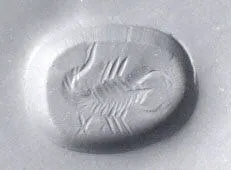
Stamp seal
Unknown Artist
ca. 3rd–7th century CE
Medium
Chalcedony, tan
Dimensions
1.02 x 0.67 x 0.83 in. (2.59 x 1.7 x 2.11 cm)
Classification
Stone-Stamp Seals
Culture & Period
Sasanian · Sasanian
Department
Ancient Near Eastern Art
Museum
Metropolitan Museum of Art, New York, NY
Credit
Gift of Martin and Sarah Cherkasky, 1983
Accession Number
1983.314.27
Rights
Public Domain
Tags
Art Historical Context
This exquisite stamp seal, crafted from tan chalcedony around the 3rd to 7th century CE, hails from the Sasanian Empire, a Persian dynasty that ruled ancient Iran and Mesopotamia. Measuring just over an inch in length, this tiny gem exemplifies the precision of Sasanian stone-carving. Stamp seals like this were essential tools in daily life, pressed into soft clay to create impressions for authenticating documents, marking property, or invoking protection in administrative and ritual contexts. The seal's design features scorpions, a motif rich in symbolism across ancient Near Eastern cultures. In Sasanian art, scorpions often represented guardianship against evil or connections to the natural world, blending Zoroastrian beliefs with everyday mysticism. Carved in intaglio—a technique where the image is incised below the surface—the chalcedony's hardness allowed for intricate details that endured repeated use, showcasing the era's masterful lapidary skills. Housed in the Metropolitan Museum of Art's Ancient Near Eastern Art department, this seal offers a window into Sasanian ingenuity, where art met utility in the heart of a vast empire. A generous gift from Martin and Sarah Cherkasky in 1983, it reminds us how small objects illuminate grand histories.