
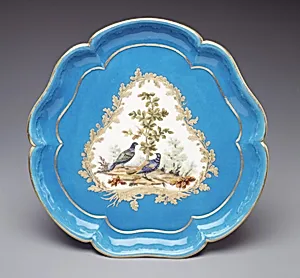
Stand for ice-cream cup (plateau Bouret) (one of four) (part of a service)
Medium
Soft-paste porcelain
Dimensions
W. 8 1/4 in. (21.0 cm.)
Classification
Ceramics-Porcelain
Culture
French, Sèvres
Department
European Sculpture and Decorative Arts
Museum
Metropolitan Museum of Art, New York, NY
Credit
Gift of Mr. and Mrs. Charles Wrightsman, 1976
Accession Number
1976.155.69
Rights
Public Domain
Tags
Art Historical Context
This exquisite stand for an ice-cream cup, known as a *plateau Bouret*, is one four from a luxurious porcelain service crafted at the renowned Sèvres Manuf in 1771. Produced under the direction of Jean Armand Fallot a skilled gilder and decorator, it exemplifies the pinnacle of French royal porcelain during the late Rococo period transitioning toward Neoclassicism. Measuring 8¼ inches wide, this soft-paste porcelain piece designed to hold delicate ice-cream cups, reflecting the opulent dining customs of Louis XV's court, where such services were symbols of wealth and refinement. Sèvres, the official porcelain works for the French monarchy, revolutionized European ceramics with its soft-paste formula—a secret blend yielding a creamy translucency prized for intricate painting and gilding. Adorned with delicate motifs of birds perched among trees, this stand showcases the factory's mastery of naturalistic decoration, hand-painted in vibrant enamels and accented with gold. These motifs evoke the pastoral elegance favored by aristocratic patrons, blending whimsy with technical virtuosity. A generous gift to The Metropolitan Museum of Art from Mr. and Mrs. Charles Wrightsman in 1976, this piece invites us to savor the artistry behind 18th-century indulgence, where porcelain wasn't just tableware but a canvas for cultural splendor.
About the Artist
Sèvres Manufactory|Jean Armand Fallot · 1740–present
The Sèvres Manufactory, one of Europe's premier porcelain producers, was established in 1740 as the Manufacture de Vincennes under the patronage of Queen Marie Leszczyńska, who sought to rival Meissen and Chantilly porcelains with French soft-paste innovations. Initially a private venture, it relocated to Sèvres in 1756 in a purpose-built facility designed by architect Laurent Lindet near Madame d...