
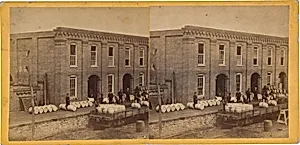
Standard Petroleum Refinery, Pittsburg, Pennsylvania
c. 1865
Medium
stereoscopic albumen prints
Dimensions
image/sheet (each): 7.6 × 8 cm (3 × 3 1/8 in.) mount: 8.2 × 17 cm (3 1/4 × 6 11/16 in.)
Classification
Photograph
Department
CPH
Museum
National Gallery of Art, Washington, D.C.
Credit
Pepita Milmore Memorial Fund
Accession Number
2017.93.16
Rights
Public Domain
Art Historical Context
This striking stereoscopic photograph captures the Standard Petroleum Refinery in Pittsburgh, Pennsylvania, around 1865, at the height of America’s early oil boom. Following Edwin Drake’s discovery of oil in nearby Titusville in 1859, Pennsylvania became the center of a rapidly expanding industry that would transform the nation’s economy. Thomas H. Johnson’s image offers a rare, contemporaneous glimpse of this industrial landscape, documenting the wooden derricks, storage tanks, and processing structures that defined the era’s energy revolution. The work is presented as a pair of albumen prints mounted for viewing in a stereoscope, a popular 19th-century device that created a convincing three-dimensional effect. This format was especially effective for conveying the scale and complexity of industrial sites to armchair travelers. Johnson’s careful composition balances the refinery’s imposing structures against the surrounding terrain, highlighting both human ingenuity and the environmental transformation underway. Today housed in the National Gallery of Art’s photography collection, the print stands as an important historical document of American industrialization. It invites viewers to consider how photography itself emerged alongside new technologies, shaping public perceptions of progress and modernity in the post-Civil War period.
About the Artist
Thomas H. Johnson · 1860–1870
Thomas H. Johnson was an American artist active in the latter half of the nineteenth century. Working during a period of considerable vitality in American art — when landscape painting, genre scenes, and printmaking were all flourishing — Johnson contributed to a visual culture that was expanding rapidly alongside the nation itself. The specifics of Johnson's training are not fully documented, th...