
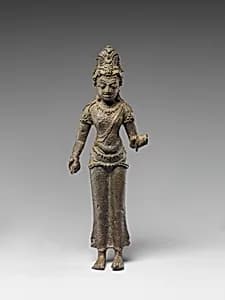
Standing Avalokiteshvara, the Bodhisattva of Infinite Compassion
Unknown Artist
late 8th–early 9th century
Medium
Bronze
Dimensions
H. 7 1/8 in. (18.1 cm); W. 2 5/8 in. (6.7 cm); D. 1 5/8 in. (4.1 cm)
Classification
Sculpture
Culture
Indonesia (Sumatra)
Department
Asian Art
Museum
Metropolitan Museum of Art, New York, NY
Credit
Gift of Jeffrey B. Soref, 1985
Accession Number
1985.401
Rights
Public Domain
Tags
Art Historical Context
This exquisite bronze sculpture depicts Avalokiteshvara, the Bodhisattva of Infinite Compassion, standing gracefully in a serene pose. Crafted by an unknown artist in Sumatra, Indonesia, during the late 8th to early 9th century, it hails from the height of the Srivijaya kingdom—a powerful maritime empire that flourished as a center of Mahayana Buddhism. At just over 7 inches tall, this intimate figure was likely created for personal devotion or portable worship, reflecting the widespread influence of Buddhist art across Southeast Asian trade routes. The bronze medium highlights advanced metallurgical skills of the era, probably achieved through lost-wax casting, allowing for intricate details like flowing robes and a gentle expression symbolizing boundless empathy. Avalokiteshvara, often depicted with multiple arms to aid suffering beings, embodies core Buddhist ideals of mercy and enlightenment delayed for others' sake. This rare Sumatran example underscores the region's role in blending Indian Buddhist iconography with local aesthetics. Now at the Metropolitan Museum of Art as a gift from Jeffrey B. Soref in 1985, it invites visitors to ponder compassion's timeless power in a turbulent world. (198 words)