
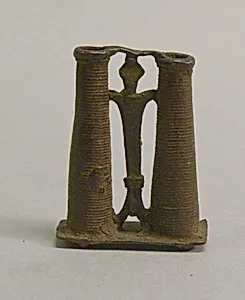
Standing Figure Between Two Posts
Unknown Artist
500 BCE–300 CE
Medium
Bronze
Dimensions
2 x 1 5/8 in. (5.1 x 4.1 cm)
Classification
Metalwork
Culture & Period
Indonesia (Java) · Bronze and Iron Age period
Department
Asian Art
Museum
Metropolitan Museum of Art, New York, NY
Credit
Samuel Eilenberg Collection, Bequest of Samuel Eilenberg, 1998
Accession Number
2001.433.527
Rights
Public Domain
Tags
Art Historical Context
This petite bronze sculpture, *Standing Figure Between Two Posts hails from ancient Java, Indonesia, during the Bronze and Iron period (500 BCE–300 CE). just 2 inches tall, it captures a solitary human figure poised between slender vertical posts, evoking a sense of ritual guardianship or sacred enclosure. Crafted by an unknown artist, its compact form suggests it was likely a votive offering or amulet, common in early Southeast Asian metalwork traditions. The use of bronze—a sophisticated alloy of copper and tin—highlights advanced lost-wax casting techniques prevalent in the region, allowing for intricate details in the figure's stance and the posts' subtle geometry. These small-scale works were prized for their portability and spiritual potency, often placed in shrines or carried for protection. Housed in the Metropolitan Museum of Art's Asian Art Department (Samuel Eilenberg Collection, Bequest of Samuel Eilenberg, 1998), this artifact offers a window into Java's pre-Hindu-Buddhist cultures, where human figures symbolized ancestors, deities, or cosmic intermediaries. Its enduring mystery invites visitors to ponder the daily rituals of a vanished world.