
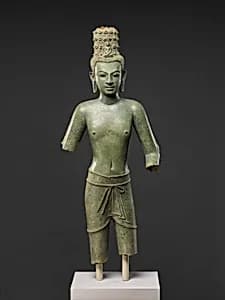
Standing Four-Armed Avalokiteshvara, the Bodhisattva of Infinite Compassion
Unknown Artist
8th–early 9th century
Medium
Bronze inlaid with obsidian(?)
Dimensions
H. 30 1/2 in. (77.5 cm)
Classification
Sculpture
Culture & Period
Thailand · pre-Angkor period
Department
Asian Art
Museum
Metropolitan Museum of Art, New York, NY
Credit
Purchase, Harris Brisbane Dick Fund and Joseph Pulitzer Bequest, 1999
Accession Number
1999.90
Rights
Public Domain
Tags
Art Historical Context
This striking bronze sculpture depicts Avalokiteshvara, the Bodhisattva of Infinite Compassion in Buddhism, standing gracefully with four arms—a divine multiplicity symbolizing his ability to aid countless beings simultaneously. Crafted in Thailand during the pre-Ang period (8th–early 9th century), it stands at an impressive 30½ inches tall, embodying the era's devotion to Mahayana Buddhist ideals. Avalokiteshvara's serene expression and elongated proportions evoke a sense of boundless empathy, inviting viewers to reflect on compassion's universal power. The unknown artist's mastery shines in the lost-wax casting technique typical of Southeast Asian bronzes, allowing intricate details like flowing robes and jewelry. Rare inlays of obsidian (or a similar dark stone) accentuate the eyes and other features, creating a mesmerizing contrast against the warm bronze patina and enhancing the figure's lifelike gaze. This pre-Angkor work from Thailand highlights early cultural exchanges along ancient trade routes, blending Indian iconography with local artistry. Today, this treasure at the Metropolitan Museum of Art (purchased in 1999) offers a window into Thailand's vibrant Buddhist heritage, reminding us how sacred sculptures once adorned temples, guiding the faithful toward enlightenment.