
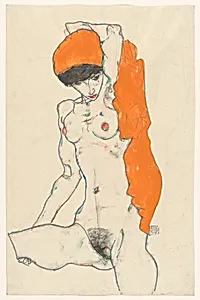
Standing Nude with Orange Drapery (recto): Study of Nude with Arms Raised (verso)
1914
Medium
Watercolor, gouache and graphite on paper
Dimensions
18 3/8 × 12 in. (46.7 × 30.5 cm)
Classification
Drawings
Department
Modern and Contemporary Art
Museum
Metropolitan Museum of Art, New York, NY
Credit
Bequest of Scofield Thayer, 1982
Accession Number
1984.433.315ab
Rights
Public Domain
Tags
Art Historical Context
Egon Schiele'sStanding Nude with Orangerapery (recto): Study of Nude with Raised (verso)* created in 1914, exemplifies Austrian Expressionist's bold exploration of the female form. Rendered in watercolor, gouache, graphite on paper, this double-sided drawing measures 18 3/8 × 12 inches. The recto features a standing nude draped in vibrant orange fabric that contrasts sharply with her pale skin, while the verso captures a dynamic of the same model with arms raised overhead, showcasing Schiele's fluid lines and psychological intensity. As a key figure in early 20th-century Viennese modernism, Schiele drew inspiration from Gustav Klimt but forged his own raw, angular style within Expressionism. His nudes, often posed vulnerably, challenged societal taboos around eroticism and the body, reflecting the cultural ferment of pre-World War I Europe. This work's mixed media allowed for luminous color and expressive distortion, techniques that made Schiele's drawings highly prized for their immediacy and emotional depth. Now in the Metropolitan Museum of Art through the 1982 bequest of Scofield Thayer, this piece invites viewers to appreciate both sides, revealing Schiele's efficient use of paper amid his prolific output before his tragic death in 1918. It's a poignant testament to his unapologetic gaze on humanity.
About the Artist
Egon Schiele · 1890–1918
Egon Schiele (1890-1918) stands as one of the most provocative and psychologically penetrating artists of early twentieth-century European modernism. Born in Tulln an der Donau, Austria-Hungary, Schiele's brief but intensely productive life ended tragically at age twenty-eight when he and his pregnant wife Edith succumbed to the Spanish flu pandemic, mere days apart. Despite his truncated career, ...