
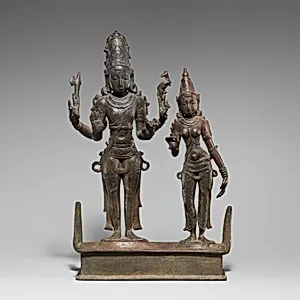
Standing Shiva and Parvati
Unknown Artist
13th century
Medium
Copper alloy
Dimensions
H. 12 3/8 in. (31.4 cm); W. 8 in. (20.3 cm); D. 3 1/8 in. (7.9 cm)
Classification
Sculpture
Culture & Period
India · Chola period (880–1279)
Department
Asian Art
Museum
Metropolitan Museum of Art, New York, NY
Credit
Samuel Eilenberg Collection, Bequest of Samuel Eilenberg, 1998
Accession Number
2000.284.5
Rights
Public Domain
Tags
Art Historical Context
This exquisite copper alloy sculpture, *Standing Shiva and Parv*, hails from India's Chola period (880–1279), a golden age of South Indian art under the Chola dynasty's patronage. Crafted in the 13th century, it the divine couple—Shiva, the cosmic destroyer and transformer, and his consort Parvati—in a graceful standing pose, embodying harmony and devotion central to Hinduism. At 12⅜ inches tall, this bronze work exemplifies the Chola mastery of lost-wax casting, a technique that allowed for fluid, naturalistic forms and intricate detailing, from flowing garments to serene expressions. Chola bronzes like this were not mere decorations but processional icons, carried in temple festivals to bring the divine closer to worshippers. The medium's warm golden patina, achieved through alloying copper with other metals, enhanced their lifelike glow under torchlight. Shiva and Parvati's union symbolizes the balance of male and female energies (Shiva-Shakti), a core Hindu concept, making this piece a profound emblem of spiritual unity. Housed in the Metropolitan Museum of Art's Asian Art department from the Samuel Eilenberg Collection, it invites us to marvel at Chola sculptors' anonymous genius—artisans whose skill elevated everyday metalwork into timeless devotion.