
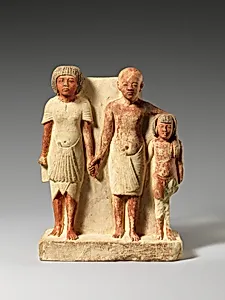
Statue of two men and a boy that served as a domestic icon
Unknown Artist
ca. 1353–1336 B.C.
Medium
Limestone, paint
Dimensions
h. 17 cm (6 11/16 in); w. 12.5 cm (4 15/16 in); D of base next to man 5.7 cm (2 1/4 in); D next to boy 4.8 cm (1 7/8 in)
Classification
Statue group, two men, boy
Period
New Kingdom, Amarna Period
Department
Egyptian Art
Museum
Metropolitan Museum of Art, New York, NY
Credit
Rogers Fund, 1911
Accession Number
11.150.21
Rights
Public Domain
Tags
About this artwork
[Research in progress for Statue of two men and a boy that served as a domestic icon by Unknown Artist, ca. 1353–1336 B.C.]
Art Historical Context
This limestone statue, created around 1353–1336 B.C. during Egypt’s New Kingdom Amarna Period, depicts two men and a boy and once served as a domestic icon for private household worship. Standing just 17 centimeters tall, the painted figure group reflects the intimate scale typical of objects meant for personal devotion rather than temple display. Its compact form and surviving traces of pigment suggest it was placed in a niche or on a small altar within a home. The Amarna Period is renowned for its distinctive artistic style, which favored more naturalistic proportions and emotional family groupings compared with earlier, more rigid Egyptian conventions. Although the artist remains unknown, the work exemplifies the era’s emphasis on everyday piety and the importance of lineage. Such domestic icons allowed ordinary Egyptians to honor ancestors or protective deities in their daily lives, offering a glimpse into the spiritual routines that existed alongside the period’s dramatic religious reforms under Akhenaten. Carved from limestone and originally brightly painted, the sculpture demonstrates the practical artistry of Dynasty 18 workshops. The choice of durable yet workable stone, combined with color to enhance lifelike details, made these small figures both affordable and meaningful keepsakes that connected families to the divine.