
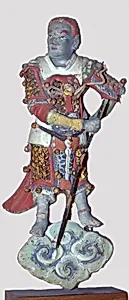
Statuette
Unknown Artist
17th century
Medium
Mud
Dimensions
H. 10 3/4 in. (27.3 cm)
Classification
Sculpture
Culture & Period
China · late Ming (1368–1644) or early Qing (1644–1911) dynasty
Department
Asian Art
Museum
Metropolitan Museum of Art, New York, NY
Credit
Rogers Fund, 1930
Accession Number
30.76.103
Rights
Public Domain
Tags
Art Historical Context
This charming statuette, standing just 10¾ inches tall, captures a male figure from 17th-century China, during the late Ming dynasty (8–1644) the early years of the Qing dynasty (4–1911). Crafted from mud—probably low-fired earthenware—this modest sculpture exemplifies the everyday artistry of the period, when China navigated a turbulent transition from native Han rule to Manchu dominance under the Qing. Such small-scale works were often produced for domestic altars, tombs, or as protective talismans, reflecting the era's blend of Confucian reverence and folk spirituality. The use of mud as a medium highlights accessible, vernacular techniques favored by unknown artisans outside imperial workshops. Unlike the refined porcelain of elite kilns, earthenware allowed for quick molding and firing, enabling widespread production of figures like this one—possibly a scholar, attendant, or guardian. Its survival into the 20th century, acquired via the Rogers Fund in 1930 for the Metropolitan Museum of Art, speaks to the enduring appeal of these humble yet expressive pieces. In the Asian Art galleries, this statuette invites us to appreciate the unsung makers who populated Chinese homes and rituals with relatable human forms, bridging the grandeur of dynastic art with intimate daily life.