
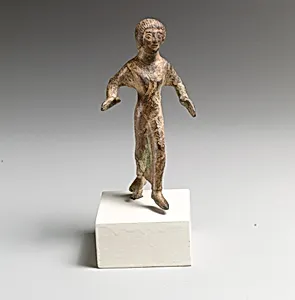
Statuette of a girl
Unknown Artist
Medium
Bronze
Dimensions
H.: 3 13/16 in. (9.7 cm)
Classification
Bronzes
Culture & Period
Greek ? · Archaic
Department
Greek and Roman Art
Museum
Metropolitan Museum of Art, New York, NY
Credit
Rogers Fund, 1913
Accession Number
13.225.3
Rights
Public Domain
Tags
Art Historical Context
This delicate bronze statuette of a girl, standing just under 4 inches tall, hails from the Archaic period of ancient Greek art (circa 700–480 BCE), a time when sculptors were pioneering more naturalistic human forms after the rigid geometry of earlier styles. Crafted by an unknown artist, it exemplifies the era's fascination with youthful figures, particularly korai—standing maidens often depicted in draped garments with one arm extended, symbolizing grace and devotion. Though its exact date and provenance remain mysteries, its tentative Greek attribution places it within a vibrant cultural milieu of city-states like Athens and Corinth, where such works adorned sanctuaries or homes. Bronze was a prized medium in Archaic Greece, cast using the lost-wax technique that allowed for intricate details like flowing hair or subtle folds in clothing—rarer survivals today, as larger bronzes were often melted for reuse. This small scale suggests it served as a votive offering to deities like Artemis or Aphrodite, invoking protection or fertility, or perhaps as a personal talisman. Its presence in the Metropolitan Museum's Greek and Roman collection, acquired via the Rogers Fund in 1913, underscores its role in illuminating everyday spirituality in antiquity. For visitors, this unassuming figure whispers of ancient lives: a girl's poised stance captures the Archaic blend of idealism and emerging realism, inviting us to ponder the anonymous hands that shaped her millennia ago.