
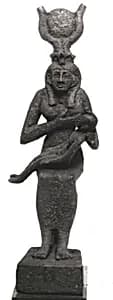
Statuette of Isis and Horus
Unknown Artist
664–332 B.C.
Medium
Copper alloy
Dimensions
h. 14.8 cm (5 13/16 in)
Classification
Statuette, Isis, Horus
Period
Late Period
Department
Egyptian Art
Museum
Metropolitan Museum of Art, New York, NY
Credit
Gift of Darius Ogden Mills, 1904
Accession Number
04.2.585
Rights
Public Domain
Tags
Art Historical Context
This exquisite copper alloy statuette from Egypt's Late Period (664332 B.C.), during Dynasties 26–30, captures the goddess Isis tenderly nursing her son Horus. Standing just 14.8 cm tall, the figure exemplifies the era's devotion to divine motherhood and protection, a motif that resonated deeply in ancient Egyptian culture. Isis, the powerful goddess of magic and healing, shields the child Horus—future king of the gods—from harm, symbolizing fertility, kingship, and the eternal cycle of life. Such statuettes were likely used as personal amulets or votive offerings in temples and homes. Crafted in copper alloy, a durable medium favored for its golden sheen and workability, the sculpture showcases Late Period artistry with its smooth, idealized forms and intimate pose. The nursing gesture, a recurring icon in Egyptian art, underscores Isis's role as the ultimate protector, especially amid the political upheavals of foreign rule by Persians and Nubians. This piece, gifted to the Metropolitan Museum of Art in 1904, invites us to ponder the timeless appeal of maternal love in one of humanity's oldest mythologies.