
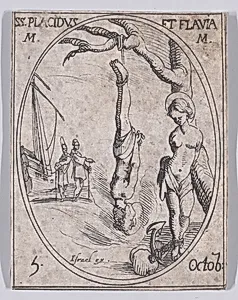
Ste. Placide et Ste. Flavie, martyres (St. Placid and St. Flavia, Martyrs), October 5th, from "Les Images De Tous Les Saincts et Saintes de L'Année" (Images of All of the Saints and Religious Events of the Year)
Medium
Etching; second state of two (Lieure)
Dimensions
Sheet: 2 9/16 x 1 15/16 in. (6.5 x 5 cm)
Classification
Prints
Department
Drawings and Prints
Museum
Metropolitan Museum of Art, New York, NY
Credit
Purchase, Joseph Pulitzer Bequest, 1917
Accession Number
17.50.17-371(350)
Rights
Public Domain
Tags
Art Historical Context
This delicate etching, *Ste. Placide et. Flavie, marty* (St. Placid and St. Flavia,rs), dated 1636, comes from Jacques Callot's renowned series *Les Images De Tous Saincts et Saintes L'Année*—a comprehensive calendar of saints and religious feasts. Created in collaboration with publisher Israël Henriet, it captures the martyrs honored on October 5th. Callot, a masterful French Baroque printmaker, was celebrated for his intricate etchings that brought dramatic religious narratives to life in miniature formats, like this one measuring just 2 9/16 x 1 15/16 inches. Etched in the second state of two (as cataloged by Lieure), the print showcases Callot's virtuoso technique: fine, expressive lines that convey emotion and movement within a tiny space. These small-scale works were designed for devotional use, allowing the faithful to carry portable icons of piety during the Counter-Reformation era, when visual aids reinforced Catholic doctrine amid Protestant challenges. Housed in the Metropolitan Museum of Art's Drawings and Prints department (purchased via the Joseph Pulitzer Bequest in 1917), this piece exemplifies 17th-century hagiographic art—elevating obscure saints like Placid and Flavia through artistry. It invites visitors to appreciate how Callot transformed spiritual history into accessible, intimate treasures.
About the Artist
Jacques Callot|Israël Henriet · 1592–1635
Jacques Callot (1592–1635) was a French printmaker and draftsman from the Duchy of Lorraine, widely regarded as one of the first great artists to practice the graphic arts exclusively. His more than 1,400 etchings chronicled the breadth of 17th-century life, from Medici court festivities to the brutal realities of warfare. Callot revolutionized etching through technical innovations including the é...