
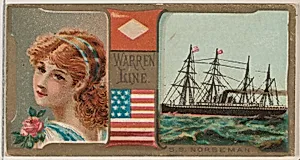
Steamship Norseman, Warren Line, from the Ocean and River Steamers series (N83) for Duke brand cigarettes
Medium
Commercial color lithograph
Dimensions
Sheet: 1 1/2 × 2 3/4 in. (3.8 × 7 cm)
Classification
Prints|Ephemera
Department
Drawings and Prints
Museum
Metropolitan Museum of Art, New York, NY
Credit
The Jefferson R. Burdick Collection, Gift of Jefferson R. Burdick
Accession Number
63.350.204.83.35
Rights
Public Domain
Tags
Art Historical Context
Step into the bustling world of 1880s advertising with *Steamship Norseman, Line*, a vibrant commercial color lithograph produced by W. Duke, & Co. in 1887. This tiny, measuring just 1½ × 2¾ inches, belongs to the Ocean and River Steamers seriesN83), a set of collectible cards inserted into Duke cigarette packs to entice smokers and spark a collecting craze. Featuring the majestic Norseman steamship alongside elegant women—evoking the era's transatlantic glamour—it captures the excitement of maritime travel during the Gilded Age. Chromolithography, the medium here, was a revolutionary color printing technique that allowed for vivid, mass-produced images at low cost, making high-quality art accessible to everyday consumers. Duke, a pioneering tobacco firm, used these ephemera to build brand loyalty, predating modern trading cards like baseball sets. Housed in the Metropolitan Museum of Art's Jefferson R. Burdick Collection, this print highlights the intersection of commerce, technology, and leisure, reflecting America's infatuation with steam-powered progress and ocean liners that shrank the world. As a snapshot of Victorian-era promotion, it reminds us how everyday objects like cigarette inserts preserved slices of history—from ship design to fashion—turning tobacco tins into treasure troves for collectors today.
About the Artist
W. Duke, Sons & Co. · 1870–1920
**W. Duke, Sons & Co.: Pioneers of Chromolithographic Trade Card Art** W. Duke, Sons & Co., an American tobacco manufacturer, emerged from the entrepreneurial vision of Washington Duke (1820–1905) and his sons in Durham, North Carolina. After the Civil War, Washington abandoned farming in 1874 to join his eldest son, Brodie L. Duke, in the burgeoning tobacco trade, establishing a factory that for...