
Stencil
Unknown Artist
19th century
Medium
Paper, silk
Dimensions
23 5/8 x 17 in. (60.0 x 43.2 cm)
Classification
Stencils
Culture
Japan
Department
Asian Art
Museum
Metropolitan Museum of Art, New York, NY
Credit
Gift of Mrs. Horace Havemeyer, 1942
Accession Number
42.91.58
Rights
Public Domain
Art Historical Context
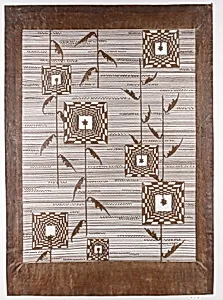
This exquisite 19th-century Japanese, crafted from delicate paper reinforced with silk threads, exemplifies masterful katagami technique honed by artisans in regions like Kyoto andachijo. Measuring 23 5/8 x 17 inches, it was designed for resist-dyeing fabrics, particularly luxurious silk kimonos, where intricate patterns were cut to allow dye to pass through while preserving fine details. The silk threads, visible in the medium, prevented the paper from tearing during repeated use, showcasing the precision and ingenuity of Japanese craftsmanship. Originating in the late Edo period and flourishing into the Meiji era, these stencils were essential to yuzen dyeing—a method that produced vibrant, hand-painted effects rivaling embroidery. They often featured motifs inspired by nature, seasons, and folklore, reflecting Japan's deep aesthetic appreciation for asymmetry and subtlety (wabi-sabi). As a utilitarian art form elevated to high craft, this stencil highlights the fusion of function and beauty in everyday luxury. Gifted to the Metropolitan Museum of Art in 1942 by Mrs. Horace Havemeyer, it invites visitors to ponder the anonymous skill behind Japan's textile golden age, bridging art and daily life in a bygone era.