
Stencil
Unknown Artist
19th century
Medium
Paper
Dimensions
19 x 12 in. (48.3 x 30.5 cm)
Classification
Stencils
Culture
Japan
Department
Asian Art
Museum
Metropolitan Museum of Art, New York, NY
Credit
Gift of Mrs. Horace Havemeyer, 1942
Accession Number
42.91.151
Rights
Public Domain
Art Historical Context
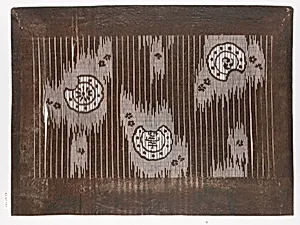
This exquisite 19th-century Japanese, crafted from paper and measuring 19 x 12 inches, exemplifies the artistry of *katagami*—delicately incised templates pivotal to traditional textile production. Housed in the Metropolitan Museum of Art's Asian Department, it was generously gifted by Mrs. Horace Havemeyer in1942. During Japan's Edo and early Meiji periods, such stencils were essential tools for artisans, enabling the precise application of dyes in the labor-intensive *yūzen* technique to create vibrant kimono patterns. Made from tough mulberry paper often treated with persimmon tannin for durability and water resistance, these stencils feature intricate cutouts that allowed resist-dyeing with rice paste, producing sharp, multi-colored designs without bleeding. Their creation demanded exceptional skill, as knife-wielding craftsmen layered silk threads between sheets to prevent tears, yielding motifs inspired by nature, theater, or daily life. As a window into Japan's craft heritage, this anonymous work highlights the fusion of utility and beauty in everyday objects, bridging fine art and functional design. Visitors can appreciate how such humble tools fueled the export boom of luxurious silks, preserving cultural motifs that continue to influence modern fashion.