
Stencil
Unknown Artist
19th Century
Medium
Paper
Dimensions
19 x 12 in. (48.26 x 30.48 cm)
Classification
Stencils
Culture
Japan
Department
Asian Art
Museum
Metropolitan Museum of Art, New York, NY
Credit
Gift of Mrs. Horace Havemeyer, 1942
Accession Number
42.91.169
Rights
Public Domain
Art Historical Context
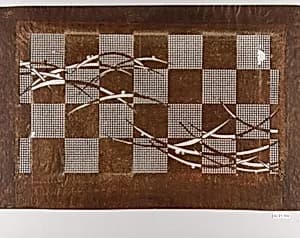
This delicate 19th-century Japanese, crafted from paper and measuring 19 x 12 inches, exemplifies the exquisite craftsmanship of Edo-period (1603–1868) and early Meiji-era (1868–1912). Housed in the Metropolitan Museum of Art's Asian Art Department, it entered the collection as a gift from Mrs. Horace Havemeyer in 2. Though the artist remains unknown, such stencils—known as *katagami*—were essential tools in traditional Japanese textile production, particularly for dyeing luxurious kimonos and fabrics. Made from tough mulberry paper, these stencils were meticulously hand-cut with tiny knives to create intricate patterns of nature motifs, geometrics, or theatrical scenes. Applied with resist paste in the *yuzen* dyeing technique, they allowed dyes to permeate only desired areas, producing vibrant, precise designs impossible with other methods. This innovation highlighted Japan's mastery of precision and impermanence, bridging art and utility. As a cultural artifact, this stencil reveals the ingenuity of anonymous workshops in places like Kyoto or Edo (modern Tokyo), where stencil-making became a specialized trade. It invites visitors to appreciate the hidden labor behind Japan's celebrated textiles, offering a window into everyday artistry that influenced global design.