
Stencil
Unknown Artist
19th century
Medium
Paper
Dimensions
24 3/4 x 16 3/4 in. (62.87 x 42.55 cm)
Classification
Stencils
Culture
Japan
Department
Asian Art
Museum
Metropolitan Museum of Art, New York, NY
Credit
Gift of Bella Mehler, in memory of Elsa S. Mehler, 1953
Accession Number
53.218.4
Rights
Public Domain
Tags
Art Historical Context
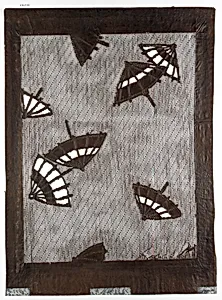
This exquisite 19th-century Japanese, crafted from paper and measuring 24¾ x 16¾ inches, offers a glimpse into the refined artistry of traditional fabric dyeing. Housed in the Metropolitan Museum of Art's Asian Department, it was generously gifted by Bella Mehler in memory of Elsa S. Mehler in 1953. The design, centered on umbrellas—a ubiquitous symbol of protection and elegance in Japanese culture—showcases the precision of *katagami*, stencils made from tough mulberry paper, intricately cut to create repeating patterns. In Edo-period and early Meiji Japan (pre-1912), such stencils were essential tools for *katazome*, a resist-dyeing technique used to adorn kimonos, noren curtains, and everyday textiles. Artisans layered multiple stencils to build complex motifs, applying rice paste through the cutouts before dyeing, resulting in vibrant, durable patterns that captured nature, daily life, and seasonal motifs like these graceful umbrellas, evoking *wagasa* (traditional parasols). Though by an unknown artist, this stencil exemplifies Japan's mastery of craft as high art, bridging utility and aesthetics. Its survival highlights the enduring appeal of these delicate yet robust objects, now treasured as standalone masterpieces in museum collections.