
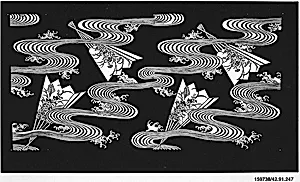
Stencil with Pattern of Fans on Water
Unknown Artist
19th century
Medium
Paper reinforced with silk
Dimensions
19 x 12 in. (48.3 x 30.5 cm)
Classification
Stencils
Culture
Japan
Department
Asian Art
Museum
Metropolitan Museum of Art, New York, NY
Credit
Gift of Mrs. Horace Havemeyer, 1942
Accession Number
42.91.247
Rights
Public Domain
Tags
Art Historical Context
In the Asian Art collection of the Metropolitan Museum of, this exquisite 19th-century Japanese, titled *Stencil with Pattern of Fans on*, captivates with its delicate motif of fans gracefully drifting across rippling water. Crafted paper reinforced with silk threads, the19 x 12-inch (48.3 x 30.5 cm) artwork exemplifies the precision of traditional katagami stencils. The silk reinforcement provided durability, allowing these tools to withstand repeated use while preserving intricate cutouts that could capture even the finest details. During Japan's Edo and early Meiji periods, stencils like this were essential for yūzen dyeing, a resist technique that produced vibrant, hand-printed patterns on silk kimonos and textiles. Artisans meticulously carved mulberry paper with tiny knives, often incorporating poetic motifs such as fans—symbols of elegance, breezy summers, and refined leisure—to reflect ukiyo-e influences and seasonal beauty. This stencil's watery scene evokes a sense of serene movement, mirroring the fluidity of Japanese aesthetics. A generous gift from Mrs. Horace Havemeyer in 1942, this piece highlights the masterful craftsmanship of anonymous Japanese stencil makers, whose innovations elevated textile arts to high art. Visitors can appreciate how such tools bridged utility and artistry, transforming everyday fabrics into wearable masterpieces.