
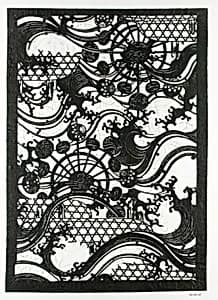
Stencil with Pattern of Flowing Water, Waterwheels and Embankment Baskets
Unknown Artist
19th century
Medium
Paper reinforced with silk
Dimensions
20 1/2 x 14 3/4 in. (52.07 x 37.47 cm)
Classification
Stencils
Culture & Period
Japan · Edo period (1615–1868)
Department
Asian Art
Museum
Metropolitan Museum of Art, New York, NY
Credit
Gift of Clarence McKenzie Lewis, 1953
Accession Number
53.101.37
Rights
Public Domain
Art Historical Context
Welcome to the Asian Art galleries at the Metropolitan Museum of Art where we encounter this exquisite 19th-century Japanese stencil from the Edo period (1615–1868). Titled *Stencil with Pattern of Flow Water, Waterwheels andbankment Baskets*, delicate work measures 20½ x 14¾ inches and is crafted from paper reinforced with silk—a clever technique that ensured durability for repeated use. The intricate design captures the rhythmic flow of water, turning waterwheels, and sturdy embankment baskets, evoking harmonious relationship with its waterways and agricultural ingenuity. Stencil-making, known as *kata* in Japan, was a pinnacle of Edo-era craftsmanship, primarily used in *katazome* resist-dyeing to create vibrant patterns on kimonos, noren curtains, and everyday fabrics. Artisans meticulously cut these motifs using fine knives and silk threads to bridge delicate areas, preventing tears during the labor-intensive printing process. This stencil's fluid, naturalistic motifs reflect the period's fascination with everyday beauty, bridging ukiyo-e woodblock prints and textile arts. A generous gift from Clarence McKenzie Lewis in 1953, this artifact highlights the precision and innovation of anonymous Japanese masters, offering a window into a thriving craft culture that democratized stunning designs for all levels of society. Pause and imagine the splash of dyes bringing this watery scene to life on silk!