
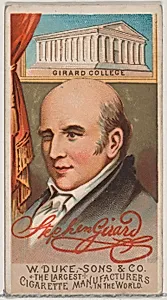
Stephen Girard, from the series Great Americans (N76) for Duke brand cigarettes
Medium
Commercial color lithograph
Dimensions
Sheet: 2 3/4 × 1 1/2 in. (7 × 3.8 cm)
Classification
Prints|Ephemera
Department
Drawings and Prints
Museum
Metropolitan Museum of Art, New York, NY
Credit
The Jefferson R. Burdick Collection, Gift of Jefferson R. Burdick
Accession Number
63.350.204.76.17
Rights
Public Domain
Tags
Art Historical Context
This vibrant chromolithograph, *Stephen Girard, from the series Great Americans (N76) for Duke brand cigarettes*, was produced in 1888 by the tobacco giant W. Duke, Sons & Co. Measuring just 2¾ × 1½ inches, it served as a collectible insert in cigarette packs, a clever marketing tactic to boost brand loyalty during the late 19th-century "cigarette card craze." These tiny cards immortalized American heroes, blending education with commerce to appeal to smokers of all ages. Stephen Girard (1750–1831), depicted here in formal attire, was a French-born Philadelphia financier and philanthropist whose shrewd investments funded ships during the War of 1812 and established Girard College for orphans. As part of the N76 series, this card celebrated national icons, reflecting the era's growing fascination with patriotic history amid rapid industrialization. Printed via color lithography—a revolutionary technique for affordable, vivid mass production—the card exemplifies commercial art's role in everyday culture. Today, preserved in the Metropolitan Museum of Art's Jefferson R. Burdick Collection, it highlights ephemera's transformation from disposable promo to prized artifact, offering a window into Gilded Age consumerism and lithography's artistic prowess.
About the Artist
W. Duke, Sons & Co. · 1870–1920
**W. Duke, Sons & Co.: Pioneers of Chromolithographic Trade Card Art** W. Duke, Sons & Co., an American tobacco manufacturer, emerged from the entrepreneurial vision of Washington Duke (1820–1905) and his sons in Durham, North Carolina. After the Civil War, Washington abandoned farming in 1874 to join his eldest son, Brodie L. Duke, in the burgeoning tobacco trade, establishing a factory that for...