
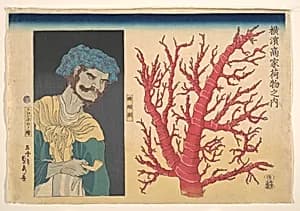
Stick of Coral and a Portrait of South Sea Islander
3rd month,1860
Medium
Woodblock print; ink and color on paper
Dimensions
Image: 10 1/4 x 14 3/4 in. (26 x 37.5 cm)
Classification
Prints
Culture & Period
Japan · Edo period (1615–1868)
Department
Asian Art
Museum
Metropolitan Museum of Art, New York, NY
Credit
Bequest of William S. Lieberman, 2005
Accession Number
2007.49.113
Rights
Public Domain
Tags
Art Historical Context
In the vibrant tradition of ukiyo-e woodblock prints, *Stick of Coral and a Portrait South Sea Islander* (1860) by Utagawa (Gountei) Sadahide captures a moment of exotic fascination during Japan's late Edo period (1615–1868). Sadahide, a of the Utagawa school and pupil of Kuniyoshi, specialized in detailed, colorful depictions of foreigners arriving in Yokohama after Commodore Perry's arrival in 1853 forced Japan open to the West. Thisōban* print (10¼ × 14¾ in.) showcases a South Sea Islander—likely a Pacific visitor or trader—posed dramatically with a coral stick, symbolizing rare oceanic treasures that intrigued Japanese audiences. Rendered in ink and color on paper through the meticulous woodblock process, the artwork highlights Sadahide's skill in fine lines, bold patterns, and vivid hues that bring the subject's tattooed skin, feathered adornments, and coral prop to life. As a prime example of *Yokohama-e*—prints glorifying foreign cultures amid Japan's isolationist sakoku policy's end—it reflects growing curiosity about the wider world just before the Meiji Restoration. Housed in the Metropolitan Museum of Art's Asian Art Department (Bequest of William S. Lieberman, 2005), this portrait invites visitors to ponder the blend of admiration and otherness in 19th-century Japanese art, bridging everyday life with global encounters.
About the Artist
Utagawa (Gountei) Sadahide · 1807–1873
Utagawa Sadahide was born Hashimoto Kenjirō in 1807 in Fusa Province, in the area of modern Chiba Prefecture, Japan. In the 1820s he entered the studio of the enormously prolific and influential master Utagawa Kunisada, becoming one of Kunisada's most prominent pupils and adopting the studio name Sadahide along with the Utagawa school's celebrated lineage. By 1828 his name appeared on a monument l...