
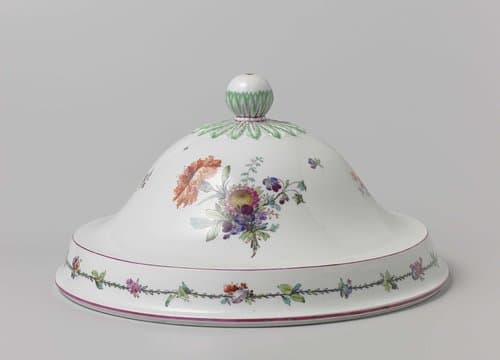
Stolp (cloche) uit een servies van Friedrich Wilhelm II van Pruisen
ca. 1780 - ca. 1785
Medium
turning
Dimensions
19.5; 36
Rights
Public Domain
About this artwork
merk, onderzijde, geschilderd, ingegrift: ‘scepter/ 3/ IIII’ scepter in onderglazuur blauw, 3 en IIII ingegrift
Art Historical Context
This elegant porcelain cloche, or food cover, was created around 1780–1785 by the Königliche Porzellan-Manufaktur (KPM) in Berlin as part of a grand dining service commissioned for Friedrich Wilhelm II of Prussia. Standing 19.5 cm high with a 36 cm diameter, the piece exemplifies the refined tableware produced for European royalty during the late eighteenth century. Its smooth, precisely turned form reflects the technical mastery of porcelain shaping at the time, when such covers were essential for maintaining the temperature and presentation of elaborate court meals. The underside bears the manufactory’s distinctive scepter mark in underglaze blue, accompanied by the engraved numbers “3” and “IIII,” confirming its royal provenance and place within the service. KPM, established in 1763 under Frederick the Great, had become renowned for its high-quality hard-paste porcelain that rivaled Meissen and Sèvres. This cloche thus represents not only fine craftsmanship but also the cultural prestige of Prussian court life on the eve of Friedrich Wilhelm II’s reign. Such objects offer visitors a tangible connection to the opulent dining rituals of the period, highlighting how porcelain served both practical and symbolic roles in royal households.