
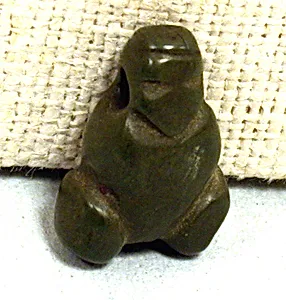
Stone Figure Pendant
Unknown Artist
9th–15th century
Medium
Stone
Dimensions
Height 3/4 in. (2 cm)
Classification
Stone-Ornaments
Culture
Costa Rica
Department
Arts of Africa, Oceania, and the Americas
Museum
Metropolitan Museum of Art, New York, NY
Credit
Bequest of Jane Costello Goldberg, from the Collection of Arnold I. Goldberg, 1986
Accession Number
1987.394.745
Rights
Public Domain
Art Historical Context
This delicate **Stone Figure Pendant** from Rica, dating to the 9th–15th century, exemplifies exquisite craftsmanship of pre-Columb indigenous cultures in the Greater Nicoya region. Carved from stone and measuring just 3/ inch (2 cm) in height, its miniature scale suggests it was worn as personal jewelry—perhaps as a necklace pendant or amulet—highlighting the portability and intimacy of ancient adornments. Belonging to the Metropolitan Museum of Art's Department of Arts of Africa, Oceania, and the Americas, this ornament reflects the artistic traditions of Costa Rican societies before European contact. Stone carving was a revered technique, often using hard local materials to create stylized human or anthropomorphic figures symbolizing fertility, protection, or spiritual connections. Such small-scale works were likely valued for both aesthetic beauty and ritual significance, carried close to the body by wearers in daily life or ceremonies. Bequeathed in 1986 through the Collection of Arnold I. Goldberg, this piece invites us to ponder the anonymous artist's skill in capturing human form with economy and grace, bridging us to a vibrant Mesoamerican world.