
Storage Jar
Unknown Artist
14th century
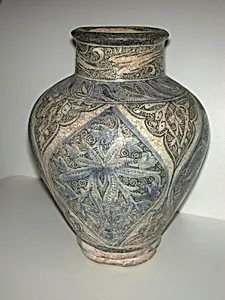
Medium
Stonepaste; polychrome painted under transparent glaze
Dimensions
H.11 1/4 in. (28.6 cm) Diam. 8 3/4 in. (22.2 cm)
Classification
Ceramics
Department
Islamic Art
Museum
Metropolitan Museum of Art, New York, NY
Credit
H.O. Havemeyer Collection, Gift of Horace Havemeyer, 1941
Accession Number
41.165.45
Rights
Public Domain
Art Historical Context
This 14th-century storage jar crafted by an unknown artist, exemplifies the ingenuity of Islamic ceramics from the medieval Islamic world, likely the eastern Mediterranean or Iran. Standing at 11¼ inches tall with an 8¾-inch diameter, it was designed for practical use—storing grains, oils, or spices—yet transformed into a work of art through its elegant and decoration. Adorned with leaf motifs a vibrant polychrome glaze, the jar evokes the lush gardens of paradise, a recurring theme in Islamic art symbolizing abundance and divine beauty. The medium, stonepaste (also known as fritware), was a groundbreaking Islamic innovation from the 10th century onward. Made from a quartz-based frit mixed with clay and glaze, it allowed potters to create a durable, white body that closely mimicked coveted Chinese porcelain, which was unavailable in the region. The polychrome painting—vibrant colors fired under a transparent glaze—added luminosity and depth, showcasing advanced glazing techniques that made these vessels both functional and luxurious. Housed in the Metropolitan Museum of Art's Islamic Art Department as part of the H.O. Havemeyer Collection, this jar highlights the cultural crossroads of trade and craftsmanship in the 14th century, blending utility with aesthetic splendor for everyday life in bustling Islamic households.