
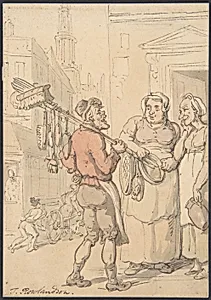
Street Scene: Vendor of Brushes
1780–1827
Medium
Watercolor
Dimensions
Sheet: 4 15/16 x 3 7/16 in. (12.6 x 8.8 cm)
Classification
Drawings
Department
Drawings and Prints
Museum
Metropolitan Museum of Art, New York, NY
Credit
Bequest of Walter Carlebach, 1969
Accession Number
69.131.2
Rights
Public Domain
Tags
Art Historical Context
Thomas Rowlandson's *Street Scene: Vendor of* (ca. 1780–1827) captures the bustling energy of everyday Georgian London in a compact watercolor, measuring just under 5 by 3 ½ inches. The British artist's signature satirical eye brings to life a vendor hawking brushes amid a mix of men and women, their interactions brimming with the humor andacity that defined Rowlandson'satures. Known for his depictions of urban life, Rowlandson often poked gentle fun at social norms, turning ordinary moments into lively vignettes. Rendered in watercolor—a medium Rowlandson mastered for its fluid transparency and vibrant washes—this drawing exemplifies his loose, expressive style within the caricature tradition. The small scale suggests it may have been a quick sketch or study, yet it packs narrative punch, highlighting the gritty commerce of 18th- and early 19th-century streets. Watercolor's portability suited Rowlandson's peripatetic career, allowing him to document the colorful chaos of markets and passersby. Today, housed in the Metropolitan Museum of Art's Drawings and Prints department (bequest of Walter Carlebach, 1969), this piece offers a window into pre-industrial street culture, where vendors like the brush seller were fixtures of community life. It's a charming reminder of how art can freeze fleeting human connections in time.
About the Artist
Thomas Rowlandson · 1756–1827
Thomas Rowlandson (1757–1827) was an English artist and caricaturist whose satirical watercolors and prints captured the social life of Georgian Britain with unparalleled wit and technical mastery. Alongside James Gillray, he is recognized as one of the greatest British graphic artists, and his distinctive flowing line and keen observations have made his work integral to understanding late 18th an...