
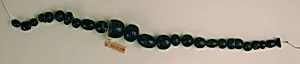
String of Beads
Unknown Artist
9th–11th century
Medium
Steatite
Dimensions
strand of 26 beads: L. 13 7/8 in. (35.2 cm) W. 13/16 in. (2.1 cm) largest bead: W. 13/16 in. (2.1 cm) Diam. 13/16 in. (2 cm) smallest bead: W. 1/2 in. (1.2 cm) Diam. 3/8 in. (0.9 cm)
Classification
Jewelry
Department
Islamic Art
Museum
Metropolitan Museum of Art, New York, NY
Credit
Rogers Fund, 1940
Accession Number
40.170.694a–z
Rights
Public Domain
Art Historical Context
This delicate strand of 26 steatite beads, dating to the 9th–11th century, offers a glimpse into the refined craftsmanship of Islamic jewelry making. Crafted from steatite—a soft, soapstone-like material prized for its workability—the beads vary in size, from the largest at 13/16 inch (2 cm) in diameter to the smallest at just 3/8 inch (0.9 cm). The entire strand measures 13 7/8 inches (35.2 cm) long and 13/16 inch (2.1 cm) wide, suggesting it was worn as a necklace or bracelet. In the Islamic world during this period, such jewelry held both aesthetic and cultural significance, adorning daily life and special occasions. Steatite's affordability and carvability made it accessible yet elegant, allowing artisans to shape uniform yet subtly varied forms through drilling and polishing techniques. The precision in sizing reflects skilled labor, likely from workshops in regions like Iraq, Iran, or Egypt under Abbasid influence. Acquired through the Rogers Fund in 1940, this piece now graces the Metropolitan Museum of Art's Islamic Art department, highlighting the enduring beauty of everyday adornments from a golden age of Islamic artistry. Visitors can appreciate how these beads bridged utility and ornament, whispering stories of wearers long past.