
Strip
Unknown Artist
18th–19th century
Medium
Wool
Dimensions
13 7/8 x 1 5/8 in. (35.2 x 4.1 cm)
Classification
Textiles-Embroidered
Culture
Hungarian, Wallachian
Department
European Sculpture and Decorative Arts
Museum
Metropolitan Museum of Art, New York, NY
Credit
Rogers Fund, 1916
Accession Number
16.127.4
Rights
Public Domain
Art Historical Context
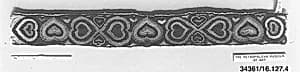
This delicate wool "Strip" is a fine example of 18th–19th embroidered textiles from Hungarian Wallachian culture, now housed in the Metropolitan Museum Art's Department of European Sculpture and Decor Arts. Measuring just 13⅞ × 1⅝ inches (35.2 × 4.1 cm), its narrow form suggests it served as a decorative border or trim—perhaps for garments, household linens, or ceremonial items in rural Eastern European life. Acquired through the Rogers Fund in 1916, it preserves a fragment of everyday artistry from a region where Wallachians, an ethnic Romanian group in historic Hungary, blended local traditions. Embroidered entirely in wool, the piece highlights skilled needlework techniques typical of folk crafts, where durable threads allowed for vibrant, intricate patterns enduring daily use. Such textiles reflect the cultural crossroads of the Carpathian Basin, fusing Hungarian motifs with Wallachian influences amid the Habsburg Empire's diverse tapestry. In a museum context, this unassuming strip underscores the artistry of anonymous makers, elevating humble materials to objects of beauty and identity. It invites visitors to appreciate how embroidery encoded stories of community, labor, and heritage in pre-industrial Europe.