
Strook gekleurd kantborduurwerk met wingerdblad
c. 1585 - c. 1599
Medium
burato
Dimensions
13; 121
Rights
Public Domain
About this artwork
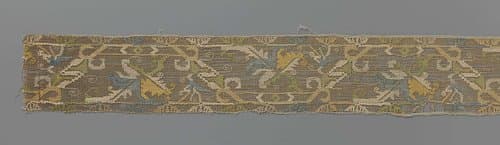
Strook gekleurd kantborduurwerk: Burato-kant. Op een slingerdraadweefsel van lichtbruine zijde en linnen is met zijdedraad in de kleuren blauw, groen, geel en crème een randpatroon in doorstoptechniek aangebracht. Het patroon bestaat uit een hoekige lopende rank, met daaraan een schuingericht wingerdblad. Omlijsting door een rij van driehoekige bladeren (?) aan een stengel.
Art Historical Context
Step into the intricate world of late Renaissance lace-making with this exquisite *Strook gekleurd kantborduurwerk met wingerdblad* (Strip of Colored Lace Embroidery with Ivy Leaf), created anonymously around 1585–1599. Measuring a slender 121 cm long by 13 cm wide, this delicate burato lace strip showcases the era's mastery of fine needlework, likely from the Low Countries where such techniques flourished. Burato, a prized Italian-influenced method, features a lightweight mesh ground woven from pale brown silk and linen threads, providing a subtle foundation that highlights the vibrant embroidery above. The design bursts with natural elegance: a sinuous, angular running vine bearing a boldly diagonal ivy leaf, rendered in rich silk threads of blue, green, yellow, and cream using the through-stop technique. This method creates raised, sculptural effects by stitching over and under the mesh, bordered by a rhythmic row of triangular leaves on slender stems. Such motifs evoked the Renaissance fascination with nature's vitality, symbolizing growth and abundance. In the 16th century, burato pieces like this adorned elite garments, cuffs, and altar cloths, embodying wealth and piety. Though anonymous, the artisan's skill reflects the unsung expertise of women lacemakers, whose work influenced fashion across Europe. A testament to enduring craftsmanship, it invites us to marvel at threads that wove history.
About the Artist
anonymous
In the vast tapestry of art history, "Anonymous" stands not as a singular individual but as a collective designation for countless unidentified creators whose works have endured across millennia. These artists, spanning prehistoric cave painters to medieval illuminators and folk craftsmen, produced the foundational layers of human visual culture. Prior to the Renaissance, when individual fame emer...