
Strook gemengde kant voor een priesterkleed
c. 1600 - c. 1699
Medium
mixed lace
Dimensions
33; 512
Rights
Public Domain
About this artwork
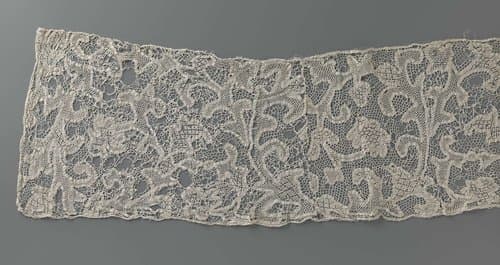
Strook naturelkleurige gemengde kant: Venetiaanse lintjeskant. Patroon van voluutranken, met grillig gevormde bloemen en acanthusbladeren op een grove zeshoekige maasgrond met vele malen gedraaide festonsteken. De contouren van het patroon worden gevormd door een geweven lint. Binnen de contouren ruime oppervlakten met verschillende open siergronden. De bovenzijde is afgezet met een rechte rand. De onderzijde is afgewerkt met een rechte picotrand met boogjes.
Art Historical Context
This exquisite strip of mixed lace, titled *Strook gemengde kant een priesterkleed (Strip of Mixed Lace for a Priest'sment), dates to the 17th century (c. 1600–1699) and measures an impressive 512 cm long by 33 cm wide. Crafted anonymously in the Venetian tape lace style—known as *lintjeskant*—it natural-colored threads forming a lavish Baroque pattern of swirling volute vines, whimsically shaped flowers, andanthus leaves. The motifs are boldly outlined with woven tape, while expansive interiors reveal varied open decorative grounds on a coarse hexagonal mesh stitched with intricate, repeatedly twisted festoon stitches. The top edge is a clean straight border, and the scalloped picot bottom adds delicate arches. Venetian lace from this era was the pinnacle of lacemaking artistry, blending woven tape with needleworked connections to create lightweight yet opulent textiles. Prized across Europe, it symbolized wealth and piety, especially for ecclesiastical vestments during the Counter-Reformation, when lavish church decorations countered Protestant austerity. This piece, likely destined for a priest's robe, showcases the technical virtuosity of Venice's lacemakers, who exported such treasures worldwide, influencing fashion and religious art for centuries. A testament to forgotten hands, it invites us to marvel at the patience behind its airy elegance.
About the Artist
anonymous
In the vast tapestry of art history, "Anonymous" stands not as a singular individual but as a collective designation for countless unidentified creators whose works have endured across millennia. These artists, spanning prehistoric cave painters to medieval illuminators and folk craftsmen, produced the foundational layers of human visual culture. Prior to the Renaissance, when individual fame emer...