
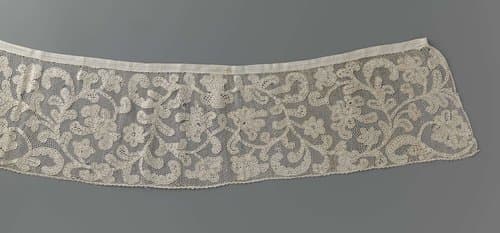
Strook gemengde kant voor een superplie met voluutranken
c. 1640 - c. 1660
Medium
mixed lace
Dimensions
20; 84; 320
Rights
Public Domain
About this artwork
lengte 320 cm x breedte 20 cm x rapportlengte 84 cm
Art Historical Context
This exquisite strip of mixed lace, titled *Strook gemengde kant voor een superplie met voluutranken*, dates to around 1640–1660 and exemplifies the golden age of Flemish and Dutch lacemaking. Created anonymously by skilled artisans, this long band—measuring 320 cm in length and 20 cm in width—was designed as ornate trim for a superplie, a loose white vestment worn by clergy during liturgical services. The repeating motif of volute vines (scrolling, vine-like patterns) reflects the exuberant Baroque style, where intricate natural forms symbolized abundance and divine order. Mixed lace, or *gemengde kant*, masterfully combines needlepoint lace (with its fine, painted-like precision) and bobbin lace (woven with threads on pillows for textured depth), showcasing the technical virtuosity of 17th-century workshops. The 84 cm rapport, or pattern repeat, allowed for efficient production of such expansive pieces, highlighting lace's role as a luxury craft that rivaled painting in complexity and value. Often imported or traded across Europe, these textiles adorned altars and vestments, blending artistry with religious devotion. In a virtual museum tour, imagine this fragile survivor draped along a surplice's edge, its delicate threads whispering of bygone eras when lace was a status symbol for the pious elite. Though anonymous, its preservation underscores the enduring cultural reverence for handmade lace in ecclesiastical art.
About the Artist
anonymous
In the vast tapestry of art history, "Anonymous" stands not as a singular individual but as a collective designation for countless unidentified creators whose works have endured across millennia. These artists, spanning prehistoric cave painters to medieval illuminators and folk craftsmen, produced the foundational layers of human visual culture. Prior to the Renaissance, when individual fame emer...