
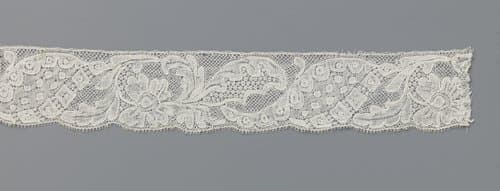
Strook kloskant met door bladeren omringde bloem en samengesteld bladvormig motief
ca. 1740 - ca. 1760
Medium
bobbin lace
Dimensions
3; 12; 45
Rights
Public Domain
About this artwork
Gift of J., Baroness van Lynden van Hemmen, Ede and A.M., Baroness van Lynden van Hemmen, Ede
Art Historical Context
This delicate strip of bobbin lace, titled *Strook kloskant met door bladeren omringde blo en samengesteld blormig motief*, the exquisite craftsmanship of mid-18th-century Europe. Dating to around 1740–1760, this anonymous work measures 45 cm long by just 3 cm wide, for adorning cuffs, collars, or fine linens. At its heart is a central flower encircled by lush leaves, paired with an intricate composite leaf motif—a harmonious blend of nature-inspired elegance typical of the Rococo era's love for organic, flowing designs. Bobbin lace, or *kloskant* in Dutch, is a labor-intensive technique where threads are twisted and plaited on bobbins over a patterned pillow, creating raised, sculptural patterns without needles. Thriving in the Netherlands and Flanders during the 17th and 18th centuries, it represented a pinnacle of artisanal skill and luxury. Such pieces were status symbols among the elite, often handmade by skilled lacemakers whose anonymity underscores the collaborative, guild-based nature of the craft. Generously donated by J. and A.M., Baronesses van Lynden van Hemmen of Ede, this lace strip preserves a slice of aristocratic heritage. It invites us to marvel at the patience behind its fine stitches, a testament to the cultural splendor of Dutch textile artistry in an age of opulent refinement.
About the Artist
anonymous
In the vast tapestry of art history, "Anonymous" stands not as a singular individual but as a collective designation for countless unidentified creators whose works have endured across millennia. These artists, spanning prehistoric cave painters to medieval illuminators and folk craftsmen, produced the foundational layers of human visual culture. Prior to the Renaissance, when individual fame emer...