
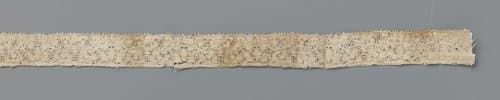
Strook kloskant met drieblad geflankeerd door rozetbloemen
ca. 1640 - ca. 1660
Medium
bobbin lace
Dimensions
151; 2
Rights
Public Domain
About this artwork
Strook naturelkleurige kloskant, oudvlaamse kant. Met kleine uitsparingen is een zich herhalend symmetrisch patroon te onderscheiden met langs de ene lange zijde een drieblad, die aan weerskanten geflankeerd wordt door een rozetbloem, en langs de andere lange zijde een gestileerde franse lelie, die aan weerskanten wordt geflankeerd door een vlindervormig blad. Er is nauwelijks sprake van een grond. De motieven zijn gemaakt in linnenslag met opengewerkte randjes. Boven- en onderzijde zijn recht a...
Art Historical Context
### Strook Kloskant met Drieblad Geflanke door Rozetbloemen This exquisite narrow strip of bobbin lace, from around 1640–1660, exemplifies the golden age of Flemish lacemaking. Measuring an impressive 151 cm long and just 2 cm wide, its natural-colored threads weave a repeating symmetrical pattern: one long edge features a central trefoil flanked bysette flowers, while the opposite side displays a stylized French lily embraced by butterfly-shaped leaves.ed in the "Oudvlaamse" (Old Flemish) style, the motifs emerge boldly with minimal ground weave, their linen-stitch solidity accented by delicate openworked edges and picots—tiny looped picot finishes along one side—for a straight, elegant finish top and bottom. Bobbin lace, or *kloskant*, was produced by skilled artisans in Flanders (modern-day Belgium), using bobbins to twist and plait fine linen threads over a paper pattern. This technique allowed for intricate, durable designs that transitioned from geometric to floral motifs during the Baroque era, reflecting the era's love for nature-inspired ornamentation. Flemish lace from this period was a luxury export, adorning the ruffs and cuffs of European nobility. As an anonymous masterpiece of collaborative craft, this piece highlights lacemaking's cultural prestige—prized for altar cloths, garments, and trims. Its preservation offers a tactile glimpse into 17th-century artistry, where every knot embodied patience and precision. (198 words)
About the Artist
anonymous
In the vast tapestry of art history, "Anonymous" stands not as a singular individual but as a collective designation for countless unidentified creators whose works have endured across millennia. These artists, spanning prehistoric cave painters to medieval illuminators and folk craftsmen, produced the foundational layers of human visual culture. Prior to the Renaissance, when individual fame emer...