
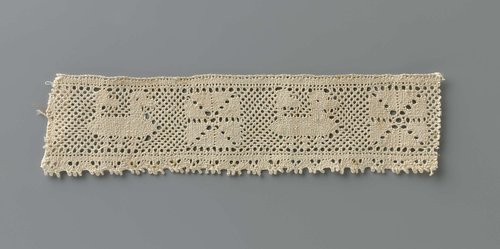
Strook kloskant met eend en vierkant
c. 1925 - c. 1938
Medium
bobbin lace
Dimensions
8.2; 4.5; 17
Rights
Public Domain
About this artwork
Schenking van mevrouw J.E. van Nierop
Art Historical Context
Welcome to our exhibit on delicate lacework traditions! This narrow strip of bobbin lace, titled *Strook kloskant eend en vierkant (Bobbin Lace Strip with Duck and Square), crafted anonymously around 1925–1938. Measuring just 17 cm by 4.5 cm wide, it features finely woven motifs of a duck and geometric square, likely intended as an edging or insertion garments, linens, or decorative borders. Bobbin lace, or *kloskant* in Dutch, is a time-honored technique originating in Europe during the Renaissance, where threads are twisted and plaited on bobbins over a patterned pillow. By the interwar period, this handmade craft persisted in regions like the Netherlands and Flanders, even as machine production rose. The anonymous creator's skill shines in the precise, textured patterns—evidence of patient, finger-guided artistry often passed down among women in lacemaking communities. A cherished gift from Mrs. J.E. van Nierop, this piece highlights the cultural endurance of folk crafts amid modernization. It invites us to appreciate the quiet elegance of everyday artistry, preserving a tactile slice of early 20th-century heritage.
About the Artist
anonymous
In the vast tapestry of art history, "Anonymous" stands not as a singular individual but as a collective designation for countless unidentified creators whose works have endured across millennia. These artists, spanning prehistoric cave painters to medieval illuminators and folk craftsmen, produced the foundational layers of human visual culture. Prior to the Renaissance, when individual fame emer...