
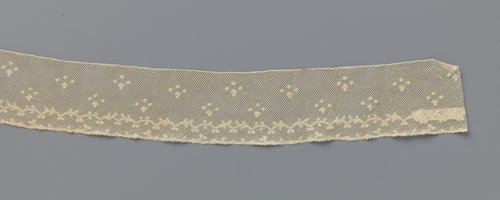
Strook kloskant met strooipatroon van blaadjes bekroond door drie losse stipjes
ca. 1785 - ca. 1799
Medium
bobbin lace
Dimensions
4.5; 7.5; 200
Rights
Public Domain
About this artwork
kloskant, traliegrond
Art Historical Context
This delicate strip of bobbin lace, *Strook kloskant met stroipatroon van blaadjes bekroond door losse stipjes*, to around 1785–1799 and exemplifies the exquisite craftsmanship of late 18th-century European lacemaking. Measuring an impressive 200 cm long just 4.5 cm wide, this narrow band was likely designed as an edging or insertion for fine garments, collars, or cuffs—status symbols among the elite during the Enlightenment era. Crafted anonymously using the bobbin lace technique (*kloskant*), it features a scattered pattern (*strooipatroon*) of leaves, each topped by three loose dots, set against a *traliegrond*—a lattice-like ground that creates an airy, openwork structure. Bobbin lace involved deftly twisting threads on weighted bobbins over a pricked pattern, demanding patience and precision. This *traliegrond* motif, resembling a geometric cage, allowed light to filter through, enhancing the lace's ethereal beauty and versatility in fashion. In historical context, such pieces from the Dutch or Flemish tradition highlight lacemaking's cultural pinnacle before industrialization diminished handmade methods. Preserved as a testament to anonymous artisans' skill, it invites us to appreciate the tactile poetry woven into everyday luxury.
About the Artist
anonymous
In the vast tapestry of art history, "Anonymous" stands not as a singular individual but as a collective designation for countless unidentified creators whose works have endured across millennia. These artists, spanning prehistoric cave painters to medieval illuminators and folk craftsmen, produced the foundational layers of human visual culture. Prior to the Renaissance, when individual fame emer...