
BK-1978-594
c. 1840 - c. 1849
Medium
bobbin lace
Dimensions
2.7; 70; 3
Rights
Public Domain
About this artwork
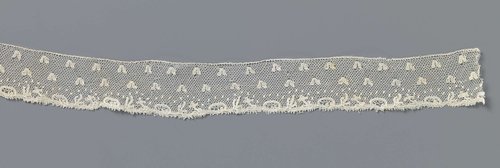
Strook naturelkleurige kloskant: Rijselse kant. De bovenste helft van het patroon bestaat uit twee rijen omgekeerde v-vormige motiefjes en langs de onderzijde uit ovaaltjes afgewisseld door twee verschillende takjes. Een verspringende rij van vierkante moesjes loopt tussen deze twee patronen door. De motieven zijn met elkaar verbonden door een fijne traliegrond, een tulegrond. Het spaarzame volwerk is gemaakt in linnenslag, met dikkere en glimmende contourdraden. In de ovaaltjes is één soort sie...
Art Historical Context
This delicate strip of natural-colored bobbin lace, known as BK-1978-594, hails from circa 1840–1849 and exemplifies the exquisite "Rijselse kant" (Lille lace) tradition from the lace-making hub of Lille, France (Rijsel in Dutch). Measuring a slender 70 cm long by 3 cm wide, it served likely as a trimming for garments or accessories during the Victorian era, when such fine laces adorned collars, cuffs, and hems as symbols of elegance and craftsmanship. The pattern reveals masterful symmetry: the upper half features two rows of inverted V-shaped motifs, while the lower edge alternates ovals with two distinct twig designs. A staggered row of square "moesjes" (small bud-like motifs) weaves between them, all linked by a fine tulle ground—a lightweight lattice that adds airy transparency. Sparse solid areas employ linen stitch with thicker, glossy outline threads for definition, and the ovals incorporate a single decorative ground. The straight top contrasts a subtly scalloped bottom finished with tiny picots, showcasing the lacemaker's precision. Created anonymously by a skilled artisan, this piece highlights bobbin lace's technical virtuosity, where threads are twisted and plaited on bobbins over a pricked pattern. In the 19th century, Lille's industry thrived on such innovations, blending Flemish heritage with French refinement, making it a coveted export that underscored lace's cultural role in fashion and femininity.
About the Artist
anonymous
In the vast tapestry of art history, "Anonymous" stands not as a singular individual but as a collective designation for countless unidentified creators whose works have endured across millennia. These artists, spanning prehistoric cave painters to medieval illuminators and folk craftsmen, produced the foundational layers of human visual culture. Prior to the Renaissance, when individual fame emer...