
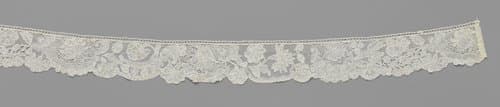
Strook kloskant met vijf varianten schulpen met bloem erboven
ca. 1750 - ca. 1760
Medium
bobbin lace
Dimensions
70; 48.5; 5
Rights
Public Domain
About this artwork
lengte 70 cm x breedte 5 cm x rapportlengte 48,5 cm
Art Historical Context
This delicate strip of bobbin lace, titled *Strook kloskant met vijfen schulpen metem erboven* (Strip Bobbin Lace with Five Variants Shells with Flower Above dates to around 1750–1760. Created anonymously, it exemplifies the exquisite craftsmanship of 18th-century European lace-making particularly from the Low Countries where bobbin lace—known as *kloskant* in Dutch—flourished. Measuring 70 cm long and just 5 cm wide, with a repeating pattern (*rapport*) of 48.5 cm, this narrow band showcases five variations of ornate shell motifs crowned by a floral element, evoking the playful asymmetry and natural motifs of the Rococo style. Bobbin lace technique involves intricately twisting and plaiting fine threads held on handheld bobbins, a labor-intensive process that demanded skilled artisans, often women in convents or workshops. During the mid-18th century, such laces were prized luxury items, adorning cuffs, collars, and trims on elite fashion or ecclesiastical vestments. Shells and flowers symbolized abundance and elegance, reflecting the era's fascination with nature's curves. Though anonymous, this piece highlights the anonymous mastery behind Europe's lace heritage, preserved as a testament to forgotten hands. Visitors might imagine it fluttering on a gown at a Versailles ball, a whisper of opulence from the Enlightenment age.
About the Artist
anonymous
In the vast tapestry of art history, "Anonymous" stands not as a singular individual but as a collective designation for countless unidentified creators whose works have endured across millennia. These artists, spanning prehistoric cave painters to medieval illuminators and folk craftsmen, produced the foundational layers of human visual culture. Prior to the Renaissance, when individual fame emer...