
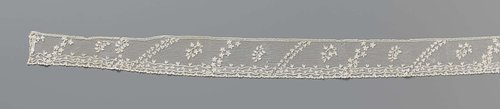
Strook naaldkant met dubbele diagonale lijnen en bladertakken
c. 1600 - c. 1799
Medium
Argentan lace
Dimensions
328; 22.5; 6.8
Rights
Public Domain
About this artwork
naaldkant, grond met mazen dicht omnaaid met knoopsgatensteken
Art Historical Context
This exquisite strip of Argentan needle lace titled *Strook naaldkant dubbele diagonale lijnen en bladertakken*, to approximately 1600–1799 exemplifies the opulent craftsmanship of early modern Europe. Measuring an impressive 328 cm in height but only 6.8 cm wide, this narrow band features double diagonal lines interwoven with delicate leaf branches, creating a rhythmic, nature-inspired pattern. Produced anonymously by skilled artisans, it highlights the era's fascination with lace as a symbol of wealth and refinement, often adorning elite garments, furnishings, or ecclesiastical textiles. Crafted entirely by needle (naaldkant), the lace employs a distinctive technique: a mesh ground meticulously sewn shut with buttonhole stitches (knoopsgatensteken). This labor-intensive method, originating in regions like Normandy's Argentan, allowed for dense, sculptural effects without bobbins, resulting in lightweight yet durable fabric that mimicked woven textiles while showcasing thread's versatility. Each stitch demanded precision, turning simple linen thread into intricate filigree. In the 17th and 18th centuries, such laces were prized across courts from Versailles to the Dutch Golden Age, embodying cultural values of piety, prosperity, and artistry. This piece invites us to marvel at the unseen hands behind Europe's lace legacy, a testament to anonymous mastery preserved through centuries.
About the Artist
anonymous
In the vast tapestry of art history, "Anonymous" stands not as a singular individual but as a collective designation for countless unidentified creators whose works have endured across millennia. These artists, spanning prehistoric cave painters to medieval illuminators and folk craftsmen, produced the foundational layers of human visual culture. Prior to the Renaissance, when individual fame emer...